Okay to Read the 1886 Edition of Marx
| Peter Singer AC | |
|---|---|
 Vocaliser in 2017 | |
| Built-in | Peter Albert David Vocalist (1946-07-06) 6 July 1946 Melbourne, Victoria, Commonwealth of australia |
| Education |
|
| Notable piece of work |
|
| Spouse(due south) | Renata Diamond (chiliad. 1968) |
| Children | 3 |
| Awards | Berggruen Prize (2021) |
| School |
|
| Institutions |
|
| Thesis | Why Should I Be Moral? (1969) |
| Academic advisors | R. M. Hare (BPhil advisor) |
| Main interests |
|
| Notable ideas |
|
| Influences
| |
| Influenced
| |
| Website | petersinger.info |
Peter Albert David Singer Ac (born 6 July 1946) is an Australian moral philosopher, currently the Ira W. DeCamp Professor of Bioethics at Princeton Academy. He specialises in applied ideals and approaches ethical issues from a secular, utilitarian perspective. He is known in particular for his book Animate being Liberation (1975), in which he argues in favour of veganism, and his essay "Famine, Affluence, and Morality", in which he argues in favour of altruistic to help the global poor. For most of his career, he was a preference commonsensical, but he stated in The Indicate of View of the Universe (2014), coauthored with Katarzyna de Lazari-Radek, that he had become a hedonistic utilitarian.
On two occasions, Vocalist served as chair of the philosophy department at Monash University, where he founded its Centre for Human Bioethics. In 1996 he stood unsuccessfully as a Greens candidate for the Australian Senate. In 2004 Singer was recognised as the Australian Humanist of the Year by the Quango of Australian Humanist Societies. In 2005, The Sydney Forenoon Herald placed him among Commonwealth of australia's ten most influential public intellectuals.[iii] Singer is a cofounder of Animals Australia and the founder of The Life You Can Save.[four]
Early life, education and career [edit]
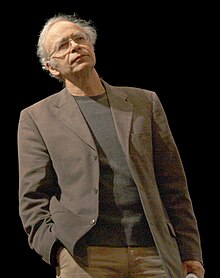
Vocalizer'due south parents were Austrian Jews who immigrated to Commonwealth of australia from Vienna later on Austria's looting past Nazi Germany in 1938.[five] They settled in Melbourne, where Singer was born. His grandparents were less fortunate: his paternal grandparents were taken by the Nazis to Łódź, and never heard from again; his maternal grandfather David Ernst Oppenheim (1881–1943), a instructor, died in the Theresienstadt concentration camp.[6] Oppenheim was a member of the Vienna Psychoanalytic Society and wrote a joint article with Sigmund Freud, before joining the Adlerian Lodge for Individual Psychology.[7] Singer afterwards wrote a biography of Oppenheim.[8]
Singer is an atheist and was raised in a prosperous, nonreligious[9] family. His father had a successful business importing tea and java.[five] His family rarely observed Jewish holidays, and Vocaliser declined to take a Bar Mitzvah.[10] Singer attended Preshil[11] and afterward Scotch College. After leaving school, Vocalist studied law, history, and philosophy at the University of Melbourne, earning a bachelor's degree in 1967.[12] He has explained that he elected to major in philosophy after his interest was piqued by discussions with his sister'southward and then-boyfriend.[thirteen]
He earned a principal'southward degree for a thesis entitled "Why Should I Be Moral?" at the same university in 1969. He was awarded a scholarship to study at the University of Oxford and obtained from there a BPhil degree in 1971 with a thesis on ceremonious disobedience supervised by R. M. Hare and published as a book in 1973.[14] Singer names Hare and Australian philosopher H. J. McCloskey every bit his two most of import mentors.[xv]
One day at Balliol College in Oxford, he had what he refers to every bit "probably the decisive determinative feel of my life". He was having a discussion later class with swain graduate student Richard Keshen, a Canadian (who would later become a professor at Cape Breton University), over lunch. Keshen opted to have a salad after being told that the spaghetti sauce contained meat. Singer had the spaghetti. Singer eventually questioned Keshen most his reason for fugitive meat. Keshen explained his ethical objections. Singer would later country, "I'd never met a vegetarian who gave such a straightforward respond that I could understand and chronicle to." Keshen later introduced Vocalizer to his vegetarian friends. Vocalizer was able to find ane book in which he could read upward on the consequence (Brute Machines by Ruth Harrison) and "inside a week or ii" he approached his wife, maxim that he idea they needed to make a change to their diet, and that he did not call back they could justify eating meat.[xvi] [17] [18]
After spending 3 years as a Radcliffe lecturer at University College, Oxford, he was a visiting professor at New York Academy for 16 months. In 1977 he returned to Melbourne, where he spent nearly of his career, aside from appointments every bit visiting kinesthesia abroad, until his move to Princeton in 1999.[19] In June 2011, it was appear he would join the professoriate of New College of the Humanities, a private higher in London, in add-on to his work at Princeton.[20] He besides has been a regular contributor to Project Syndicate since 2001.
According to philosopher Helga Kuhse, Vocaliser is "almost certainly the best-known and most widely read of all contemporary philosophers".[21] Michael Specter wrote that Singer is among the most influential of gimmicky philosophers.[22]
Applied ideals [edit]
Vocalist'south Practical Ethics (1979) analyzes why and how living beings' interests should be weighed. His principle of equal consideration of interests does not dictate equal treatment of all those with interests, since different interests warrant unlike handling. All have an interest in fugitive pain, for example, but relatively few have an interest in cultivating their abilities. Not only does his principle justify unlike treatment for different interests, but it allows different treatment for the aforementioned interest when diminishing marginal utility is a cistron. For example, this approach would privilege a starving person'due south involvement in food over the same interest of someone who is just slightly hungry.
Among the more important human interests are those in avoiding hurting, in developing one's abilities, in satisfying bones needs for nutrient and shelter, in enjoying warm personal relationships, in being gratis to pursue 1's projects without interference, "and many others". The central interest that entitles a existence to equal consideration is the chapters for "suffering and/or enjoyment or happiness". Singer holds that a beingness's interests should ever exist weighed according to that beingness's concrete properties. He favors a "journey" model of life, which measures the wrongness of taking a life past the degree to which doing so frustrates a life journey's goals. So taking a life is less wrong at the beginning, when no goals have been prepare, and at the end, when the goals have either been met or are unlikely to be accomplished. The journey model is tolerant of some frustrated desire and explains why persons who have embarked on their journeys are non replaceable. But a personal interest in continuing to live brings the journey model into play. This model besides explains the priority that Singer attaches to interests over trivial desires and pleasures.
Upstanding conduct is justified by reasons that go beyond prudence to "something bigger than the individual", addressing a larger audience. Singer thinks this going-beyond identifies moral reasons every bit "somehow universal", specifically in the injunction to 'love thy neighbor as thyself', interpreted by him every bit demanding that one requite the same weight to the interests of others equally ane gives to one's own interests. This universalising step, which Singer traces from Kant to Hare,[23] : eleven is crucial and sets him apart from those moral theorists, from Hobbes to David Gauthier, who tie morality to prudence. Universalisation leads directly to utilitarianism, Singer argues, on the strength of the thought that one's own interests cannot count for more than the interests of others.[24]
Taking these into account, 1 must counterbalance them up and adopt the course of activity that is nearly likely to maximise the interests of those affected; utilitarianism has been arrived at. Vocaliser's universalising pace applies to interests without reference to who has them, whereas the Kantian's applies to the judgments of rational agents (in Kant's kingdom of Ends, or Rawls's original position, etc.). Vocaliser regards Kantian universalisation every bit unjust to animals.[25] As for the Hobbesians, Vocalist attempts a response in the final chapter of Practical Ethics, arguing that self-interested reasons support adoption of the moral point of view, such as 'the paradox of hedonism', which counsels that happiness is all-time constitute past not looking for it, and the need most people experience to relate to something larger than their ain concerns.
Vocaliser identifies as a sentientist.[26] Sentientism is a naturalistic worldview that grants moral consideration to all sentient beings.
Effective altruism and world poverty [edit]

Vocaliser at an constructive altruism conference in Melbourne in 2015
Singer'southward ideas accept contributed to the rising of effective altruism.[27] He argues that people should attempt not only to reduce suffering simply to reduce information technology in the most effective manner possible. While Vocalizer has previously written at length nigh the moral imperative to reduce poverty and eliminate the suffering of nonhuman animals, peculiarly in the meat industry, he writes about how the effective altruism motion is doing these things more than finer in his 2015 book The Most Adept You Tin can Do. He is a board member of Animal Charity Evaluators, a charity evaluator used by many members of the effective altruism community which recommends the nearly cost-effective fauna advocacy charities and interventions.[28]
His own system, The Life Y'all Tin can Salve, besides recommends a selection of charities deemed by charity evaluators such as GiveWell to exist the most effective when information technology comes to helping those in extreme poverty. TLYCS was founded after Singer released his 2009 eponymous book, in which he argues more by and large in favour of giving to charities that aid to end global poverty. In detail, he expands upon some of the arguments made in his 1972 essay "Famine, Affluence, and Morality", in which he posits that citizens of rich nations are morally obligated to give at least some of their disposable income to charities that help the global poor. He supports this using the "drowning child analogy", which states that nearly people would rescue a drowning kid from a swimming, even if it meant that their expensive clothes were ruined, so we clearly value a human being life more the value of our textile possessions. As a result, we should take a significant portion of the money that we spend on our possessions and instead donate it to charity.[29] [30]
Since November 2009, Singer is a member of Giving What Nosotros Can, an international organization whose members pledge to give at least 10% of their income to effective charities.[31]
Animal liberation and speciesism [edit]
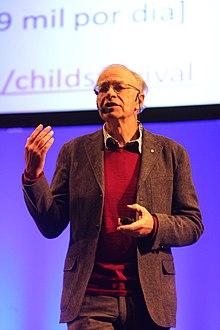
Published in 1975, Animal Liberation [32] has been cited as a formative influence on leaders of the modern animal liberation movement.[33] The central argument of the volume is an expansion of the utilitarian concept that "the greatest good of the greatest number" is the only mensurate of skillful or ethical behaviour, and Vocalizer believes that there is no reason not to utilize this principle to other animals, arguing that the boundary between human and "creature" is completely arbitrary. There are far more differences between a smashing ape and an oyster, for example, than between a human and a great ape, and yet the old two are lumped together equally "animals", whereas we are considered "human being" in a way that supposedly differentiates us from all other "animals."
He popularised the term "speciesism", which had been coined by English author Richard D. Ryder to describe the exercise of privileging humans over other animals, and therefore argues in favour of the equal consideration of interests of all sentient beings.[34] In Creature Liberation, Vocalizer argues in favour of veganism and against creature experimentation. Vocalizer describes himself every bit a flexible vegan. He writes, "I am largely vegan but I'm a flexible vegan. I don't go to the supermarket and buy non-vegan stuff for myself. But when I'one thousand traveling or going to other people'due south places I will be quite happy to eat vegetarian rather than vegan."[35]
In an commodity for the online publication Chinadialogue, Singer called Western-style meat production barbarous, unhealthy, and damaging to the ecosystem.[36] He rejected the thought that the method was necessary to meet the population'south increasing demand, explaining that animals in factory farms have to eat nutrient grown explicitly for them, and they burn down upwardly most of the food'southward energy just to breathe and continue their bodies warm. In a 2010 Guardian article he titled, "Fish: the forgotten victims on our plate", Vocaliser drew attention to the welfare of fish. He quoted author Alison Mood's startling statistics from a report she wrote, which was released on fishcount.org.great britain but a month earlier the Guardian article. Singer states that she "has put together what may well be the beginning-ever systematic estimate of the size of the almanac global capture of wild fish. Information technology is, she calculates, in the social club of one trillion, although information technology could be as high as 2.7tn."[37] [38]
Some chapters of Creature Liberation are dedicated to criticising testing on animals but, unlike groups such as PETA, Singer is willing to accept such testing when at that place is a clear do good for medicine. In Nov 2006, Singer appeared on the BBC plan Monkeys, Rats and Me: Brute Testing and said that he felt that Tipu Aziz's experiments on monkeys for research into treating Parkinson's disease could be justified.[39] Whereas Singer has continued since the publication of Animal Liberation to promote vegetarianism and veganism, he has been much less vocal in contempo years on the discipline of animal experimentation.
Singer has defended some of the actions of the Animal Liberation Front, such every bit the stealing of footage from Dr. Thomas Gennarelli's laboratory in May 1984 (as shown in the documentary Unnecessary Fuss), but he has condemned other actions such as the employ of explosives by some animal-rights activists and sees the freeing of convict animals as largely futile when they are easily replaced.[forty] [41]
Singer features in the 2017 documentary Empathy, directed by Ed Antoja, which aims to promote a more than respectful fashion of life towards all animals. The documentary won the "Public Selection Laurels" of the Greenpeace Picture Festival.[42]
Other views [edit]
Meta-ethical views [edit]
In the past, Vocalist has non held that objective moral values be, on the basis that reason could favour both egoism and equal consideration of interests. Singer himself adopted utilitarianism on the basis that people's preferences can be universalised, leading to a situation where one takes the "point of view of the universe" and "an impartial standpoint". Simply in the Second Edition of Practical Ideals, he concedes that the question of why nosotros should act morally "cannot exist given an respond that will provide anybody with overwhelming reasons for acting morally".[23] : 335
However, when co-authoring The Signal of View of the Universe (2014), Singer shifted to the position that objective moral values do exist, and defends the 19th century commonsensical philosopher Henry Sidgwick's view that objective morality can be derived from fundamental moral axioms that are knowable by reason. Additionally, he endorses Derek Parfit's view that at that place are object-given reasons for activeness.[43] : 126 Furthermore, Singer and Katarzyna de Lazari-Radek (the co-writer of the volume) argue that evolutionary debunking arguments can be used to demonstrate that it is more rational to take the impartial standpoint of "the betoken of view of the universe", as opposed to egoism—pursuing one's ain cocky-interest—because the existence of egoism is more likely to exist the product of evolution by natural pick, rather than considering information technology is correct, whereas taking an impartial standpoint and as because the interests of all sentient beings is in disharmonize with what we would expect from natural selection, meaning that information technology is more likely that impartiality in ethics is the right opinion to pursue.[43] : 182–183
Political views [edit]
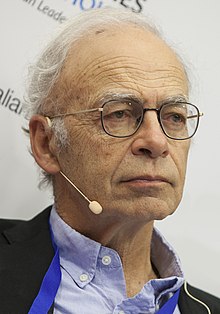
Whilst a pupil in Melbourne, Singer campaigned against the Vietnam War as president of the Melbourne University Campaign Against Conscription.[44] He too spoke publicly for the legalisation of abortion in Australia.[44] Vocalizer joined the Australian Labor Political party in 1974, but resigned after disillusionment with the centrist leadership of Bob Hawke.[45] In 1992, he became a founding member of the Victorian Greens.[45] He has run for political role twice for the Greens: in 1994 he received 28% of the vote in the Kooyong by-election, and in 1996 he received three% of the vote when running for the Senate (elected past proportional representation).[45] Before the 1996 ballot, he co-authored a volume The Greens with Bob Brown.[46]
In A Darwinian Left,[47] Singer outlines a plan for the political left to adapt to the lessons of evolutionary biology. He says that evolutionary psychology suggests that humans naturally tend to be self-interested. He further argues that the evidence that selfish tendencies are natural must non be taken as testify that selfishness is "right." He concludes that game theory (the mathematical report of strategy) and experiments in psychology offer hope that self-interested people will make short-term sacrifices for the skillful of others, if society provides the right conditions. Substantially, Vocalizer claims that although humans possess selfish, competitive tendencies naturally, they have a substantial chapters for cooperation that also has been selected for during human evolution. Vocalizer's writing in Greater Good magazine, published past the Greater Proficient Science Centre of the University of California, Berkeley, includes the interpretation of scientific enquiry into the roots of pity, altruism, and peaceful human relationships.
Singer has criticised the U.s.a. for receiving "oil from countries run by dictators ... who pocket most of the" financial gains, thus "keeping the people in poverty." Vocalist believes that the wealth of these countries "should vest to the people" within them rather than their "de facto authorities. In paying dictators for their oil, we are in effect buying stolen goods, and helping to keep people in poverty." Vocalist holds that America "should be doing more than to assist people in extreme poverty". He is disappointed in U.S. foreign aid policy, deeming it "a very small proportion of our GDP, less than a quarter of some other affluent nations." Singer maintains that fiddling "individual philanthropy from the U.Due south." is "directed to helping people in extreme poverty, although there are some exceptions, most notably, of grade, the Gates Foundation."[48]
Vocalizer describes himself every bit not anti-backer, stating in a 2010 interview with the New Left Projection:[49]
Capitalism is very far from a perfect organisation, but so far we accept yet to find anything that clearly does a better chore of coming together human being needs than a regulated capitalist economic system coupled with a welfare and health care organization that meets the bones needs of those who practice not thrive in the capitalist economic system.
He added that "[i]f we always do observe a better organisation, I'll be happy to call myself an anti-capitalist".
Similarly, in his book Marx, Vocalizer is sympathetic to Marx'due south criticism of commercialism, but is skeptical nearly whether a better organization is likely to be created, writing: "Marx saw that capitalism is a wasteful, irrational system, a system which controls us when we should be controlling it. That insight is still valid; but we can now see that the construction of a free and equal society is a more difficult task than Marx realised."[50]
Vocalist is opposed to the death penalty, claiming that information technology does not effectively deter the crimes for which it is the castigating measure out,[51] and that he cannot see any other justification for information technology.[52]
In 2010, Singer signed a petition renouncing his right of render to State of israel, considering it is "a form of racist privilege that abets the colonial oppression of the Palestinians."[53]
In 2016, Singer called on Jill Stein to withdraw from the United states of america presidential election in states that were close between Hillary Clinton and Donald Trump, on the grounds that "The stakes are too high".[54] He argued confronting the view that there was no pregnant difference betwixt Clinton and Trump, whilst also maxim that he would not advocate such a tactic in Australia's electoral system, which allows for ranking of preferences.[54]
When writing in 2017 on Trump's deprival of climatic change and plans to withdraw from the Paris accords, Singer advocated a cold-shoulder of all consumer appurtenances from the United States to force per unit area the Trump administration to change its environmental policies.[55] [56]
In 2021, Singer described the War on Drugs every bit an expensive, ineffective and extremely harmful policy.[57]
Abortion, euthanasia, and infanticide [edit]
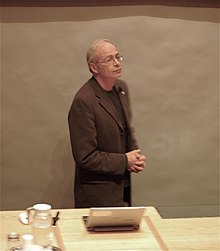
Singer holds that the right to life is substantially tied to a beingness's capacity to hold preferences, which in turn is essentially tied to a beingness's capacity to feel pain and pleasance.
In Practical Ethics, Vocalizer argues in favour of abortion rights on the grounds that fetuses are neither rational nor cocky-aware, and tin can therefore concord no preferences. Every bit a result, he argues that the preference of a mother to have an abortion automatically takes precedence. In sum, Vocalizer argues that a fetus lacks personhood.
Like to his argument for abortion rights, Singer argues that newborns lack the essential characteristics of personhood—"rationality, autonomy, and self-consciousness"[58]—and therefore "killing a newborn baby is never equivalent to killing a person, that is, a beingness who wants to go on living".[59] Singer has clarified that his "view of when life begins isn't very different from that of opponents of abortion." He deems it non "unreasonable to hold that an individual human life begins at conception. If information technology doesn't, then it begins about 14 days subsequently, when it is no longer possible for the embryo to dissever into twins or other multiples." Vocalist disagrees with abortion rights opponents in that he does not "think that the fact that an embryo is a living human beingness is sufficient to show that information technology is wrong to kill it." Singer wishes "to see American jurisprudence, and the national abortion debate, have upward the question of which capacities a human beingness needs to take in order for it to be wrong to kill it" as well every bit "when, in the evolution of the early homo being, these capacities are present."[60]
Singer classifies euthanasia as voluntary, involuntary, or not-voluntary. Voluntary euthanasia is that to which the subject consents. He argues in favour of voluntary euthanasia and some forms of not-voluntary euthanasia, including infanticide in certain instances, but opposes involuntary euthanasia.
Bioethicists associated with the inability rights and disability studies communities have argued that his epistemology is based on ableist conceptions of inability.[61] Vocalist'southward positions have besides been criticised by some advocates for inability rights and right-to-life supporters, concerned with what they see as his attacks upon human dignity. Religious critics have argued that Singer'southward ethics ignores and undermines the traditional notion of the sanctity of life. Vocalist agrees and believes the notion of the sanctity of life ought to be discarded as outdated, unscientific, and irrelevant to understanding bug in contemporary bioethics.[62] Inability rights activist take held many protests against Singer at Princeton University and at his lectures over the years. Vocaliser has replied that many people judge him based on secondhand summaries and curt quotations taken out of context, not on his books or articles, and that his aim is to elevate the status of animals, non to lower that of humans.[63]
American publisher Steve Forbes ceased his donations to Princeton University in 1999 because of Singer's date to a prestigious professorship.[64] Nazi-hunter Simon Wiesenthal wrote to organisers of a Swedish volume fair to which Vocalizer was invited that "A professor of morals ... who justifies the right to impale handicapped newborns ... is in my opinion unacceptable for representation at your level."[65] Marc Maurer, president of the National Federation of the Bullheaded, criticised Singer's appointment to the Princeton faculty in a banquet speech at the organisation's national convention in July 2001, challenge that Vocaliser'due south back up for euthanising disabled babies could pb to disabled older children and adults existence valued less every bit well.[66] Conservative psychiatrist Theodore Dalrymple wrote in 2010 that Singerian moral universalism is "preposterous—psychologically, theoretically, and practically".[67]
In 2002, disability rights activist Harriet McBryde Johnson debated Vocalizer, challenging his belief that it is morally permissible to euthanise newborn children with severe disabilities. "Unspeakable Conversations", Johnson's account of her encounters with Singer and the pro-euthanasia motion, was published in the New York Times Magazine in 2003.[68]
In 2015, Singer debated Archbishop Anthony Fisher on the legalisation of euthanasia at Sydney Town Hall.[69] Singer rejected arguments that legalising euthanasia would consequence in a slippery gradient where the practice might get widespread as a means to remove undesirable people for financial or other motives.[seventy]
Singer has experienced the complexities of some of these questions in his own life. His female parent had Alzheimer's illness. He said, "I think this has made me see how the issues of someone with these kinds of issues are really very difficult".[71] In an interview with Ronald Bailey, published in December 2000, he explained that his sister shares the responsibility of making decisions about his mother. He did say that, if he were solely responsible, his mother might not continue to live.[72]
Surrogacy [edit]
In 1985, Vocaliser wrote a book with the physician Deanne Wells arguing that surrogate motherhood should be allowed and regulated past the land past establishing nonprofit 'Land Surrogacy Boards', which would ensure fairness between surrogate mothers and surrogacy-seeking parents. Vocalist and Wells endorsed both the payment of medical expenses endured past surrogate mothers and an extra "fair fee" to recoup the surrogate mother.[73] [74]
Organized religion [edit]

Singer was a speaker at the 2012 Global Atheist Convention.[75] He has debated with Christians including John Lennox[76] and Dinesh D'Souza.[77] Singer has pointed to the problem of evil as an objection confronting the Christian conception of God. He stated: "The evidence of our own eyes makes it more than plausible to believe that the earth was not created by whatever god at all. If, however, we insist on assertive in divine creation, we are forced to acknowledge that the god who fabricated the globe cannot be all-powerful and all good. He must be either evil or a bungler."[78] In keeping with his considerations of nonhuman animals, Vocalist too takes upshot with the original sin reply to the problem of evil, maxim that, "animals besides suffer from floods, fires, and droughts, and, since they are non descended from Adam and Eve, they cannot have inherited original sin."[78]
Medical intervention in the aging process [edit]
Singer supports biogerontologist Aubrey de Greyness's view that medical intervention into the crumbling process would exercise more to amend human being life than research on therapies for specific chronic diseases, particularly in the developed world:
In adult countries, crumbling is the ultimate cause of 90 per cent of all man deaths. Thus, treating aging is a course of preventive medicine for all of the diseases of sometime age. Moreover, fifty-fifty before aging leads to our death, information technology reduces our capacity to enjoy our lives and to contribute positively to the lives of others. So, instead of targeting specific diseases that are much more likely to occur when people have reached a sure age, wouldn't a better strategy exist to try to prevent or repair the damage done to our bodies past the aging procedure?[79]
Vocaliser does worry that "If nosotros observe how to slow crumbling, we might have a world in which the poor majority must face up expiry at a fourth dimension when members of the rich minority are only a 10th of the way through their expected lifespans," thus risking "that overcoming aging will increment the stock of injustice in the world."[79] However, Vocalizer charily highlights de Grey's view that as with other medical developments, they will reach the more economically disadvantaged over fourth dimension once developed, whereas they can never practise then if they are not.[79] As to the concern that longer lives might contribute to overpopulation, Singer notes that "success in overcoming aging could itself ... delay or eliminate menopause, enabling women to have their first children much later on than they can now" and thus slowing the birth charge per unit, and also that technology may reduce the consequences of ascent man populations past (for example) enabling more zip-greenhouse gas free energy sources.[79]
In 2012, Singer'due south department sponsored the "Scientific discipline and Ethics of Eliminating Aging" seminar at Princeton, featuring de Greyness.[fourscore]
Protests [edit]

In 1989 and 1990, Singer'south work was the bailiwick of a number of protests in Germany. A course in ethics led by Hartmut Kliemt at the Academy of Duisburg where the main text used was Singer's Practical Ethics was, according to Singer, "subjected to organised and repeated disruption past protesters objecting to the use of the book on the grounds that in one of its ten chapters information technology advocates active euthanasia for severely disabled newborn infants". The protests led to the course beingness close down.[81]
When Singer tried to speak during a lecture at Saarbrücken, he was interrupted by a grouping of protesters including advocates for disability rights. One of the protesters expressed that entering serious discussions would be a tactical error.[82]
The aforementioned year, Singer was invited to speak in Marburg at a European symposium on "Bioengineering, Ethics and Mental Disability". The invitation was fiercely attacked by leading intellectuals and organisations in the German media, with an article in Der Spiegel comparing Vocalizer'south positions to Nazism. Eventually, the symposium was cancelled and Singer'south invitation withdrawn.[83]
A lecture at the Zoological Constitute of the University of Zurich was interrupted past 2 groups of protesters. The first group was a group of disabled people who staged a brief protestation at the beginning of the lecture. They objected to inviting an advocate of euthanasia to speak. At the end of this protestation, when Singer tried to address their concerns, a 2nd group of protesters rose and began chanting "Singer raus! Vocaliser raus!" ("Singer out!") When Vocalist attempted to reply, a protester jumped on phase and grabbed his glasses, and the host ended the lecture. Singer explains "my views are not threatening to anyone, even minimally" and says that some groups play on the anxieties of those who hear but keywords that are understandably worrying (given the constant fears of ever repeating the Holocaust) if taken with any less than the full context of his belief system.[23] : 346–359 [84]
In 1991, Singer was due to speak along with R. M. Hare and Georg Meggle at the 15th International Wittgenstein Symposium in Kirchberg am Wechsel, Austria. Singer has stated that threats were made to Adolf Hübner, and then the president of the Austrian Ludwig Wittgenstein Society, that the conference would exist disrupted if Singer and Meggle were given a platform. Hübner proposed to the board of the lodge that Singer'southward invitation (as well as the invitations of a number of other speakers) exist withdrawn. The Social club decided to abolish the symposium.[81]
In an article originally published in The New York Review of Books, Singer argued that the protests dramatically increased the amount of coverage he received: "instead of a few hundred people hearing views at lectures in Marburg and Dortmund, several millions read about them or listened to them on television". Despite this, Vocalizer argues that information technology has led to a difficult intellectual climate, with professors in Germany unable to teach courses on applied ideals and campaigns demanding the resignation of professors who invited Singer to speak.[81]
Criticism [edit]
Vocaliser was criticised by Nathan J. Robinson, founder of Current Affairs, for comments in an op-ed defending Anna Stubblefield, a carer and professor who was convicted of aggravated sexual attack confronting a man with severe concrete and intellectual disabilities. The op-ed questioned whether the victim was capable of giving or withholding consent, and stated that "It seems reasonable to assume that the experience was pleasurable to him; for fifty-fifty if he is cognitively dumb, he was capable of struggling to resist." Robinson called the statements "outrageous" and "morally repulsive", and said that they implied that it might be permissible to rape or sexually assault disabled people.[85]
Roger Scruton was critical of the consequentialist, utilitarian approach of Peter Singer.[86] Scruton alleged that Singer'south works, including Fauna Liberation (1975), "comprise little or no philosophical argument. They derive their radical moral conclusions from a vacuous utilitarianism that counts the pain and pleasure of all living things as as significant and that ignores just nearly everything that has been said in our philosophical tradition about the real distinction between persons and animals."[86]
Anthropologists have criticised Singer's foundational essay "Fauna Liberation" (1973) for comparing the interests of "slum children" with the interests of the rats that bite them – at a time when poor and predominantly Black American children were indeed regularly attacked and bitten by rats, sometimes fatally.[87]
Recognition [edit]
Singer was inducted into the United states of america Brute Rights Hall of Fame in 2000.[88]
In June 2012, Vocalizer was appointed a Companion of the Guild of Australia (Ac) for "eminent service to philosophy and bioethics equally a leader of public debate and communicator of ideas in the areas of global poverty, animal welfare and the human status."[89]
Singer received Philosophy Now 's 2016 Laurels for Contributions in the Fight Confronting Stupidity for his efforts "to disturb the comfy complacency with which many of united states habitually ignore the desperate needs of others ... particularly for this work as information technology relates to the Effective Altruism movement."[ninety]
In 2018, Singer was noted in the volume, Rescuing Ladybugs [91] by writer and brute advocate Jennifer Skiff equally a "hero among heroes in the world," who, in arguing confronting speciesism "gave the modern earth permission to believe what we innately know – that animals are sentient and that we have a moral obligation non to exploit or mistreat them."[91] : 132 The book states that Singer'due south "moral philosophy on animal equality was sparked when he asked a fellow student at Oxford University a simple question about his eating habits."[91] : 133
In 2021, Singer was awarded the US$1-million Berggruen Prize,[92] and decided to give it away. He decided, in particular, to requite half of the prize coin to his foundation The Life You Can Save, considering "over the last iii years, each dollar spent past it generated an average of $17 in donations for its recommended nonprofits". (He added he has never taken coin for personal use from the organization.) Moreover, he plans to donate more than a third of the money to organizations combating intensive animal farming, and recommended as constructive by Animal Charity Evaluators.[93]
Personal life [edit]
Since 1968, he has been married to Renata Singer (née Diamond; b. 1947 Walbrzych, Poland); they have three children: Ruth, a textile artist; Marion, constabulary student and youth arts specialist; and Esther, linguist and teacher. Renata Singer is a novelist and author and has collaborated on publications with her husband.[94] Until 2021 she was President of the Kadimah Jewish Cultural Heart and National Library in Melbourne.[95]
The Singers divided their time between Brighton, a bayside suburb of Melbourne, and New York for many years. They now live elsewhere in Melbourne.[ commendation needed ]
Publications [edit]
[edit]
- Democracy and Defiance, Clarendon Press, Oxford, 1973; Oxford University Press, New York, 1974; Gregg Revivals, Aldershot, Hampshire, 1994
- Animal Liberation: A New Ethics for our Handling of Animals, New York Review/Random House, New York, 1975; Cape, London, 1976; Avon, New York, 1977; Paladin, London, 1977; Thorsons, London, 1983. Harper Perennial Modern Classics, New York, 2002. Harper Perennial Modern Classics, New York, 2009.
- Practical Ethics, Cambridge University Press, Cambridge, 1980; second edition, 1993; third edition, 2011. ISBN 0-521-22920-0, ISBN 0-521-29720-vi, ISBN 978-0-521-70768-eight
- Marx, Oxford University Press, Oxford, 1980; Hill & Wang, New York, 1980; reissued as Marx: A Very Short Introduction, Oxford University Printing, 2000; besides included in full in One thousand. Thomas (ed.), Great Political Thinkers: Machiavelli, Hobbes, Mill and Marx, Oxford Academy Press, Oxford, 1992
- The Expanding Circle: Ethics and Sociobiology, Farrar, Straus and Giroux, New York, 1981; Oxford University Press, Oxford, 1981; New American Library, New York, 1982. ISBN 0-19-283038-four
- Hegel, Oxford University Printing, Oxford and New York, 1982; reissued equally Hegel: A Very Short Introduction, Oxford University Press, 2001; also included in full in German Philosophers: Kant, Hegel, Schopenhauer, Nietzsche, Oxford Academy Printing, Oxford, 1997
- How Are We to Live? Ideals in an Age of Self-interest, Text Publishing, Melbourne, 1993; Mandarin, London, 1995; Prometheus, Buffalo, NY, 1995; Oxford University Press, Oxford, 1997
- Rethinking Life and Death: The Collapse of Our Traditional Ideals, Text Publishing, Melbourne, 1994; St Martin's Press, New York, 1995; reprint 2008. ISBN 0-312-11880-5 Oxford University Press, Oxford, 1995
- Ethics into Action: Henry Spira and the Creature Rights Motion, Rowman and Littlefield, Lanham, Maryland, 1998; Melbourne Academy Printing, Melbourne, 1999
- A Darwinian Left, Weidenfeld and Nicolson, London, 1999; Yale University Printing, New Oasis, 2000. ISBN 0-300-08323-8
- One World: The Ethics of Globalisation, Yale Academy Press, New Oasis, 2002; Text Publishing, Melbourne, 2002; 2nd edition, pb, Yale University Press, 2004; Oxford Longman, Hyderabad, 2004. ISBN 0-300-09686-0
- Pushing Fourth dimension Away: My Grandfather and the Tragedy of Jewish Vienna, Ecco Printing, New York, 2003; HarperCollins Australia, Melbourne, 2003; Granta, London, 2004
- The President of Good and Evil: The Ethics of George W. Bush, Dutton, New York, 2004; Granta, London, 2004; Text, Melbourne, 2004. ISBN 0-525-94813-9
- The Life You lot Tin can Salve: Acting Now to End Globe Poverty. New York: Random House 2009.[96]
- The Most Expert You Can Do: How Effective Altruism Is Irresolute Ideas Well-nigh Living Ethically. Yale University Press, 2015.[97]
- Ethics in the Existent World: 82 Cursory Essays on Things That Matter. Princeton University Press, 2016.[97]
- Why Vegan? Eating Ethically. Liveright, 2020.
Coauthored books [edit]
- Brute Factories (co-author with James Mason), Crown, New York, 1980
- The Reproduction Revolution: New Means of Making Babies (co-author with Deane Wells), Oxford University Press, Oxford, 1984. revised American edition, Making Babies, Scribner's New York, 1985
- Animal Liberation: A Graphic Guide (co-author with Lori Gruen), Camden Press, London, 1987
- Should the Baby Live? The Problem of Handicapped Infants (co-author with Helga Kuhse), Oxford University Press, Oxford, 1985; Oxford University Press, New York, 1986; Gregg Revivals, Aldershot, Hampshire, 1994. ISBN 0-19-217745-1
- Upstanding and Legal Issues in Guardianship Options for Intellectually Disadvantaged People (co-writer with Terry Carney), Homo Rights Commission Monograph Serial, no. 2, Australian Government Publishing Service, Canberra, 1986
- How Upstanding is Australia? An Examination of Commonwealth of australia's Record as a Global Citizen (with Tom Gregg), Black Inc, Melbourne, 2004
- The Ethics of What We Eat: Why Our Food Choices Matter (or The Mode We Eat: Why Our Food Choices Matter), Rodale, New York, 2006 (co-author with Jim Mason); Text, Melbourne; Random House, London. Audio version: Playaway. ISBN 1-57954-889-10
- Eating (co-authored with Jim Bricklayer), Arrow, London, 2006
- Stem Cell Enquiry: the ethical issues. (co-edited by Lori Gruen, Laura Grabel, and Peter Singer). New York: Blackwells. 2007.
- The Future of Brute Farming: Renewing the Ancient Contract (with Marian Stamp Dawkins, and Roland Bonney) 2008. New York: Wiley-Blackwell.
- The Point of View of the Universe: Sidgwick and Contemporary Ethics (with Katarzyna de Lazari-Radek), Oxford University Printing, 2014
- Utilitarianism: A Very Curt Introduction (with Katarzyna de Lazari-Radek), Oxford Academy Press, 2017
Edited and coedited volumes and anthologies [edit]
- Test-Tube Babies: a guide to moral questions, nowadays techniques, and future possibilities (co-edited with William Walters), Oxford University Printing, Melbourne, 1982
- Animal Rights and Human Obligations: An Anthology (co-editor with Tom Regan), Prentice-Hall, New Bailiwick of jersey, 1976. 2nd revised edition, Prentice-Hall, New Jersey, 1989
- In Defence of Animals (ed.), Blackwells, Oxford, 1985; Harper & Row, New York, 1986. ISBN 0-631-13897-viii
- Applied Ethics (ed.), Oxford University Press, Oxford, 1986
- Embryo Experimentation (co-editor with Helga Kuhse, Stephen Buckle, Karen Dawson and Pascal Kasimba), Cambridge University Press, Cambridge, 1990; paperback edition, updated, 1993
- A Companion to Ideals (ed.), Basil Blackwell, Oxford, 1991; paperback edition, 1993
- Salve the Animals! (Australian edition, co-writer with Barbara Dover and Ingrid Newkirk), Collins Angus & Robertson, North Ryde, NSW, 1991
- The Corking Ape Project: Equality Across Humanity (co-editor with Paola Cavalieri), Quaternary Estate, London, 1993; hardback, St Martin's Press, New York, 1994; paperback, St Martin'due south Printing, New York, 1995
- Ethics (ed.), Oxford University Press, Oxford, 1994
- Individuals, Humans and Persons: Questions of Life and Death (co-author with Helga Kuhse), Academia Verlag, Sankt Augustin, Germany, 1994
- The Greens (co-author with Bob Dark-brown), Text Publishing, Melbourne, 1996
- The Allotment of Wellness Care Resources: An Upstanding Evaluation of the "QALY" Approach (co-author with John McKie, Jeff Richardson and Helga Kuhse), Ashgate/Dartmouth, Aldershot, 1998
- A Companion to Bioethics (co-editor with Helga Kuhse), Blackwell, Oxford, 1998
- Bioethics. An Album (co-editor with Helga Kuhse), Blackwell, 1999/ Oxford, 2006
- The Moral of the Story: An Anthology of Ethics Through Literature (co-edited with Renata Singer), Blackwell, Oxford, 2005
- In Defense of Animals. The Second Moving ridge (ed.), Blackwell, Oxford, 2005
- The Bioethics Reader: Editors' Choice. (co-editor with Ruth Chadwick, Helga Kuhse, Willem Landman and Udo Schüklenk). New York: Blackwell, 2007
- J. M. Coetzee and Ethics: Philosophical Perspectives on Literature (co-editor with A. Leist), New York: Columbia University Press, 2010
- The Golden Ass, past Apuleius (edited and abridged by Peter Vocalizer, translated by Ellen D. Finkelpearl), New York: Liveright Publishing Corporation; London: Westward.West. Norton and Visitor, Ltd., 2021
Anthologies of Singer'due south work [edit]
- Writings on an Ethical Life, Ecco, New York, 2000; Fourth Estate, London, 2001. ISBN 0-06-019838-nine
- Unsanctifying Human Life: Essays on Ideals (edited past Helga Kuhse), Blackwell, Oxford, 2001
[edit]
- Jamieson, Dale (ed.). Singer and His Critics. Wiley-Blackwell, 1999
- Schaler, Jeffrey A. (ed.). Peter Singer Under Fire: The Moral Iconoclast Faces His Critics. Chicago: Open up Court Publishers, 2009
- Davidow, Ben (ed.). "Peter Singer" Uncaged: Top Activists Share Their Wisdom on Constructive Farm Fauna Advocacy. Davidow Press, 2013
Run into also [edit]
- Animal liberation motion
- Animal liberationist
- Argument from marginal cases
- Demandingness objection
- Effective altruism
- Intrinsic value (animal ethics)
- Listing of brute rights advocates
- Utilitarian bioethics
- Utilitarianism
- Veganism
References [edit]
- ^ "Animals and Ethics". Internet Encyclopedia of Philosophy . Retrieved 27 October 2018.
- ^ "Peter Vocalizer's top x books". The Guardian. 5 April 2001. Retrieved 27 October 2018.
- ^ Visontay, Michael (12 March 2005). "Australia's pinnacle 100 public intellectuals". The Sydney Forenoon Herald . Retrieved 27 October 2018.
- ^ "The Life Yous Tin Save".
- ^ a b Thompson, Peter (28 May 2007). "Talking Heads – Peter Singer". Australian Dissemination Corporation. Archived from the original on 25 May 2013. Retrieved 27 October 2018.
- ^ Singer, Peter (2003). Pushing Fourth dimension Away: My Grandfather and the Tragedy of Jewish Vienna. Pymble, NSW: Fourth Estate. pp. Chapter 33–Theresienstadt. ISBN0-7322-7742-6.
- ^ Mühlleitner, Elke (1992). Biographisches Lexikon der Psychoanalyse: Die Mitglieder der Psychologischen Mittwoch-Gesellschaft und der Wiener Psychoanalytischen Vereinigung 1902–1938 (in German). Tübingen: Edition Diskord. pp. 239–240. ISBN978-3-89295-557-three.
- ^ Singer, Peter (2007). Pushing Time Away: My Grandfather and the Tragedy of Jewish Vienna. Fourth Estate. ISBN978-0-7322-7742-0 . Retrieved 27 October 2018.
- ^ "Peter Singer". whatisitliketobeaphilosopher.com . Retrieved 3 February 2019.
- ^ Specter, Michael (21 Nov 1999). "ETHICS MAN". The Independent . Retrieved 27 October 2018.
- ^ Suzannah Pearce, ed. (17 November 2006). "RICHARDSON (Sue) Susan." Who's Who in Australia Alive! Northward Melbourne, Vic: Crown Content Pty Ltd.
- ^ Vulliamy, Ed (xv February 2009). "Peter Singer". The Guardian. London. Retrieved 27 October 2018.
- ^ "Peter Singer talk, "My Life in Philosophy: The Point of View of the Universe and Its Implications for Ethics, Fauna Liberation and Constructive Altruism". Graz, Austria: Universität Graz. 7 June 2017. Retrieved 27 October 2018.
- ^ Singer, Peter (1973). Democracy and Disobedience . Oxford: Clarendon Press. ISBN978-0-nineteen-824504-9.
- ^ Appel, Jacob Chiliad. (July 2004). "Interview with Peter Singer: Philosopher as Educator". Education Update Online . Retrieved 27 October 2018.
- ^ "The Ethics of Nutrient: The Making of a Vegetarian and Professor of Bioethics – Peter Singer". YouTube. ane October 2013. Archived from the original on eleven December 2021. Retrieved 27 October 2018.
- ^ "Peter Singer: Eine bessere Welt für Mensch und Tier". YouTube. Universität Graz, in Graz, Republic of austria. 7 June 2017. Retrieved 28 October 2018.
Finding Ruth Harrison's volume Animal Machines at 23m36s. - ^ Vocalizer, Peter (2000). Writings on an Ethical Life. p. 258. ISBN9781497645585.
Notation: In this version of the story, Vocalist writes of the conversion process of himself and his wife happening "Over the next two months". - ^ "Peter Singer: About Me". Retrieved 28 Oct 2018.
"Centre for Practical Philosophy and Public Ideals". Archived from the original on 24 October 2009. Retrieved 28 October 2018.
"Peter Singer: Works". Retrieved 28 October 2018.
"Peter Vocaliser: Life & Work". Retrieved 28 Oct 2018.
"Peter Singer: BBC/RSA Iconoclasts series Pt. 1". London. 5 September 2006. Archived from the original on 12 October 2006. Retrieved 28 Oct 2018.
"Columnist Peter Singer". Retrieved 28 October 2018.
Singer, Peter (1 March 2006). "Can You Do Good by Eating Well?". Greater Good Mag . Retrieved 28 October 2018.
Singer, Peter (5 September 1999). "The Singer Solution to Earth Poverty". Retrieved 28 October 2018.
Singer, Peter. "All Animals Are Equal" (PDF). Archived from the original (PDF) on 29 February 2008. Retrieved 28 Oct 2018. - ^ "The professoriate". New Higher of the Humanities. Retrieved 28 Oct 2018.
- ^ Kuhse, Helga, ed. (2002). Unsanctifying human being life: Essays on ethics. New York: Blackwell. p. ii. ISBN978-0-631-22507-2.
- ^ Specter, Michael (6 September 1999). "The Unsafe Philosopher". The New Yorker . Retrieved 28 October 2018.
- ^ a b c Vocalizer, Peter (1993). Applied Ethics (2nd ed.). Cambridge University Press. ISBN978-0-521-43971-viii . Retrieved 28 October 2018.
- ^ Animal Liberation, pp. 211, 256
- ^ Creature Liberation, pp. 211, 256
- ^ Vocalizer, Peter (2009). Animal Liberation. Harper Collins. ISBN978-0-06-171130-v.
- ^ Jollimore, Troy (half dozen February 2017). "Impartiality". Stanford Encyclopedia of Philosophy. Metaphysics Research Lab, Stanford University. Retrieved 28 October 2018.
- ^ "Lath of Directors". Retrieved 28 Oct 2018.
- ^ Vocalizer, Peter (April 1997). "The Drowning Child and the Expanding Circumvolve". The Internationalist. Retrieved 28 October 2018.
- ^ Skelton, Anthony. "Nobody can practice everything, but everyone can practise something". The Globe and Postal service . Retrieved 28 October 2018.
- ^ Giving What We Can. "Members". Retrieved 25 September 2020.
- ^ Animal Liberation: A New Ethics for our Handling of Animals. New York: Random House. 1975. ISBN978-0-394-40096-9.
- ^ "Karen Dawn's Biography". ThankingTheMonkey.com. Retrieved 28 Oct 2018.
- ^ Waldau, Paul (2001). The Specter of Speciesism: Buddhist and Christian Views of Animals. Oxford University Printing. pp. 5, 23–29.
- ^ "Chew the Correct Affair". motherjones.com. Retrieved 17 February 2022.
- ^ Singer, Peter (30 August 2006). "The ideals of eating". chinadialogue.net . Retrieved 28 October 2018.
- ^ "Fish: the forgotten victims on our plate". The Guardian. fourteen September 2010. ISSN 0261-3077. Retrieved 28 Oct 2018.
- ^ Mood, Alison (2010). Worse things happen at sea: the welfare of wild-caught fish (PDF). fishcount.org.uk. Retrieved 28 Oct 2018.
- ^ Mangan, Lucy (28 November 2006). "Last nighttime's TV". The Guardian. London. Retrieved 28 Oct 2018.
- ^ Singer, Peter (28 October 2011). Practical Ethics (3rd ed.). UK: Cambridge University Press. p. 274. ISBN978-1-139-49689-six.
- ^ Singer, Peter (2015). Animal Liberation (preface in 2015 revised ed.). UK: Random House. p. xxix. ISBN978-1-4735-2442-ii.
- ^ "Projection de film : Empathy (Complet)". VegEvents . Retrieved 13 May 2021.
- ^ a b de Lazari-Radek, Katarzyna; Vocalizer, Peter (2014). The Point of View of the Universe: Sidgwick and Contemporary Ethics. Oxford University Press.
- ^ a b Schaler, Jeffrey A. (xxx September 2011). Peter Singer Under Fire: The Moral Iconoclast Faces His Critics. Open Court. p. vii. ISBN978-0-8126-9769-viii.
- ^ a b c Schaler, Jeffrey A. (30 September 2011). Peter Vocalist Under Burn down: The Moral Iconoclast Faces His Critics. Open up Courtroom. pp. 58–59. ISBN978-0-8126-9769-viii.
- ^ Singer, Peter; Brown, Bob (28 Oct 1996). The Greens. Text Publishing Company. ISBN978-1-875847-17-4.
- ^ Vocalizer, Peter (2000). A Darwinian Left: Politics, Development, and Cooperation. New Haven: Yale University Press. ISBN978-0-300-08323-1.
- ^ Cotto, Joseph Ford (26 September 2017). "Interview: How do practical ideals work in the average American'southward life? Peter Vocaliser explains". San Francisco Review of Books. Archived from the original on 31 October 2017. Retrieved 28 Oct 2018.
- ^ Vocalizer, Peter; Lewis, Edward (16 March 2010). "Ideals and the Left". Newleftproject.org. Retrieved 28 October 2018.
- ^ Vocalist, Peter (2000). Marx: A Very Brusk Introduction . Oxford University Printing. p. 100. ISBN978-0-xix-285405-6 . Retrieved 28 October 2018.
- ^ Singer, Peter (12 Oct 2011). "The Capital punishment – Once again". Project Syndicate . Retrieved 28 October 2018.
- ^ Singer, Peter; Kennedy, Julia Taylor (17 October 2011). "ETHICS Affair: A Chat with Peter Singer". Policy Innovations. Archived from the original on 8 May 2017. Retrieved 28 October 2018.
- ^ Goldberg, Dan (xvi August 2012). "Peter Singer: is he really the most dangerous man in the world?". The Jewish Chronicle . Retrieved 28 October 2018.
- ^ a b Singer, Peter (11 August 2016). "Greens for Trump?". Project Syndicate . Retrieved 28 October 2018.
- ^ Singer, Peter (6 April 2017). "Boycott America?". Project Syndicate . Retrieved 28 October 2018.
- ^ Singer, Peter (v June 2017). "Is the Paris Accord Unfair to America?". Project Syndicate . Retrieved 28 October 2018.
- ^ Plant, Michael; Vocalist, Peter (4 May 2021). "Why drugs should be not only decriminalised, but fully legalised". www.newstatesman.com . Retrieved 22 May 2021.
{{cite web}}: CS1 maint: url-status (link) - ^ Taking Life: Humans, Excerpted from Practical Ethics, 2nd edition, 1993
- ^ Vocalist, Peter. "Peter Singer FAQ". Retrieved 28 October 2018.
- ^ Cotto, Joseph Ford (27 September 2017). "When does man life brainstorm -- and what does this really mean? Peter Singer explains". San Francisco Review of Books. Archived from the original on 17 Jan 2021. Retrieved 28 October 2018.
- ^ Vocalist, Peter (2001). "An Interview". Writings on an Ethical Life. pp. 319–329. ISBN978-ane-84115-550-0.
- ^ Singer, Peter Rithinking Life and Expiry: The Plummet of our Traditional Ethics, Text Publishing, 1994.
- ^ Vocaliser, Peter (1993). Practical Ethics . Cambridge University Press. pp. 77–78. ISBN978-0-521-43971-viii . Retrieved 28 October 2018.
[T]he aim of my argument is to elevate the condition of animals rather than to lower the status of any humans
- ^ "Steve Forbes Declines Princeton Financial Backing Due to Vocaliser Hiring". Euthanasia.com. 21 September 1999. Retrieved 28 October 2018.
- ^ Felder, Don (28 October 1998). "Professor Death will fit correct in at Princeton". Jewish World Review. Retrieved 28 October 2018.
- ^ "Independence and the Necessity for Diplomacy". Nfb.org. vi July 2001. Retrieved 28 October 2018.
- ^ Dalrymple, Theodore (2010). Spoilt Rotten: The Toxic Cult of Sentimentality. Gibson Square Books Ltd. p. 226. ISBN978-1-906142-61-2.
- ^ McBryde Johnson, Harriet (16 Feb 2003). "Unspeakable Conversations". The New York Times Magazine . Retrieved 28 October 2018.
- ^ Corderoy, Amy (8 August 2015). "Euthanasia argue: Archbishop Anthony Fisher and ethicist Peter Vocalist to debate euthanasia". The Sydney Morning Herald . Retrieved half-dozen October 2021.
- ^ Jones, Benjamin (14 August 2015). "Vocalizer and Fisher preach to their flocks in euthanasia debate". The Conversation . Retrieved 6 October 2021.
- ^ "The Unsafe Philosopher". Michael Specter. 6 September 1999. Retrieved 28 October 2018.
- ^ Bailey, Ronald (December 2000). "The Pursuit of Happiness, Peter Singer interviewed by Ronald Bailey". Reason . Retrieved 28 October 2018.
- ^ Vocalizer, Peter; Wells, Deane (1987). Making Babies: The New Scientific discipline and Ethics of Formulation. C. Scribner's Sons.
- ^ Tong, Rosemarie (7 March 2003). "Affiliate 27: Surrogate Motherhood". In Frey, R. G.; Wellman, Christopher Heath (eds.). A Companion to Applied Ethics. p. 376. ISBN978-1-55786-594-6.
- ^ "Peter Singer". .atheistconvention.org.au. Archived from the original on 1 Dec 2013. Retrieved 28 October 2018.
- ^ "Singer vs Lennox: Is There a God?". ABC.net.au. vi September 2011. Archived from the original on 27 November 2016. Retrieved 28 October 2018.
- ^ Jaasiewicz, Isia (28 January 2009). "Vocaliser, D'Souza face off over religion and morality". Princeton Alumni Weekly . Retrieved 28 October 2018.
- ^ a b Peter Singer (8 May 2008). "The God of Suffering?". Project Syndicate. Archived from the original on 7 July 2015. Retrieved 28 October 2018.
- ^ a b c d Singer, Peter (27 December 2012). "Should nosotros live to 1,000?". The Globe and Postal service . Retrieved 4 June 2021.
- ^ Wang, Angela (four Oct 2012). "Scholar on aging argues people can now live to 1,000". The Daily Princetonian . Retrieved five June 2021.
- ^ a b c Vocalizer, Peter (2001). "On Being Silenced in Deutschland". Writings on an Ethical Life. pp. 303–318. ISBN978-1-84115-550-0.
- ^ Holger Dorf, "Singer in Saabrücken", Unirevue (Winter Semester, 1989/ninety), p.47.
- ^ Berman, Sheri (Fall 1999). "Euthanasia, Eugenics and Fascism: How Close are the Connections" (PDF). High german Politics and Gild 17(3). Archived from the original (PDF) on 2 Apr 2012. Retrieved 28 October 2018.
- ^ "Criticanarede.com". Criticanarede.com. 31 May 2005. Archived from the original on 22 January 2011. Retrieved 28 October 2018.
- ^ Robinson, Nathan J. (4 April 2017). "Now Peter Singer argues that it might be okay to rape disabled people". Electric current Affairs . Retrieved 21 April 2019.
- ^ a b Scruton, Roger (2017). On Human Nature. Princeton and Oxford: Princeton University Printing. p. 91. ISBN978-0-691-18303-9.
- ^ Cherkaev, Xenia. "Zoo-Fascism, Russia: To Hell with Equality and Ownerless Dogs". Society for Cultural Anthropology . Retrieved 18 April 2021.
- ^ "U.S. Animal Rights Hall of Fame". Beast Rights National Conference. Archived from the original on half-dozen February 2016. Retrieved 28 Oct 2018.
- ^ "Companion (AC) in the General Partitioning of the Order of Commonwealth of australia – The Queen'south Birthday 2012 Honours Lists" (PDF). Official Secretarial assistant to the Governor-General of Australia. sixteen June 2012. p. 8. Retrieved 28 October 2018.
- ^ "The Philosophy Now Award for Contributions in the Fight Confronting Stupidity". Philosophy At present. Retrieved 28 October 2018.
- ^ a b c Jennifer Skiff, Rescuing Ladybugs: Inspirational Encounters with Animals That Changed the Earth, New World Library, 2018
- ^ Schuessler, Jennifer (7 September 2021). "Peter Singer Wins $1 Million Berggruen Prize". The New York Times. ISSN 0362-4331. Retrieved 7 September 2021.
- ^ Singer, Peter (7 September 2021). "How to give away a million dollars". Project Syndicate . Retrieved 16 September 2021.
- ^ Jeffries, Stuart (22 July 2005). "Moral maze". The Guardian . Retrieved 28 October 2018.
- ^ "Renata Singer". Kadimah Jewish Cultural Heart and National Library . Retrieved 4 December 2021.
{{cite spider web}}: CS1 maint: url-status (link) - ^ Reviewed at Garner, Dwight (ten March 2009). "If Yous Think You're Good, You Should Call back Once again". The New York Times . Retrieved 28 October 2018.
- ^ a b Camosy, Charles (2018). "Book Reviews: Peter Vocalist, The Near Skilful You Can Practice: How Effective Altruism is Changing Ideas Well-nigh Living Ethically and Peter Vocalizer, Ethics in the Real World: 82 Brief Essays on Things That Affair". Studies in Christian Ideals. 31 (3): 370–373. doi:ten.1177/0953946818769552u. S2CID 149797021. Retrieved 28 October 2018.
External links [edit]
- Official website

- Column annal at Project Syndicate
- Appearances on C-SPAN
- Peter Vocalist at IMDb
- An in-depth autobiographical interview with Vocalist
- Peter Singer, biographical profile, including quotes and further resources, at Utilitarianism.net.
Source: https://en.wikipedia.org/wiki/Peter_Singer
0 Response to "Okay to Read the 1886 Edition of Marx"
Enviar um comentário